Home › Guide › Example: fruit seller
🍎 Example: Abu Ali's Fruit Cart
Abu Ali buys fruit by the crate at the wholesale market, tens of kilos at a time, and sells it from his cart in small amounts: half a kilo, a kilo and a half, or "a dollar's worth of apples". Here he sets up his book with the eight steps of Step by step, then we follow a week of his work: selling by the gram and by money, spoiled fruit, closing the day, and which fruit earns most. All names and figures are made up.
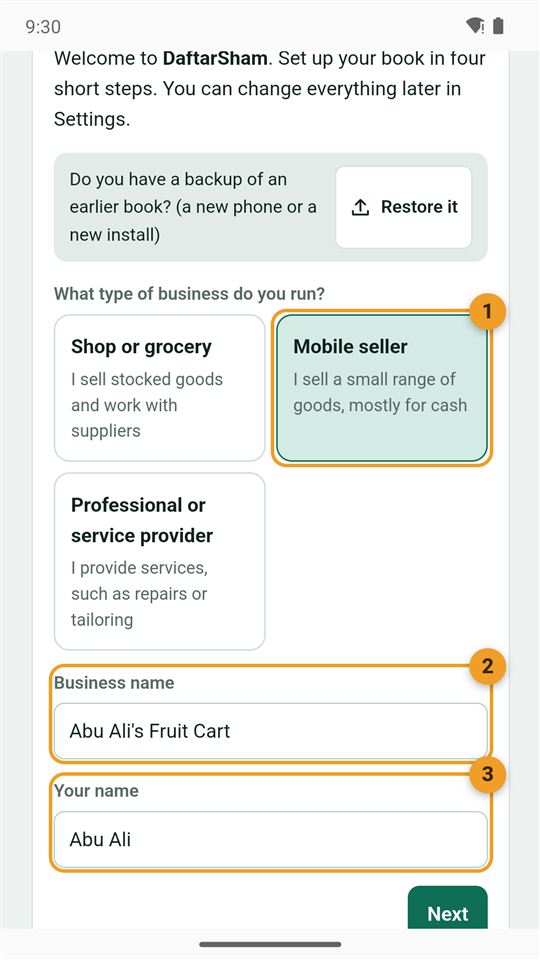
1. First setup
- "Mobile seller": a few goods, mostly sold for cash.
- Business name: "Abu Ali's Fruit Cart".
- His name: "Abu Ali".
Then the US dollar, $120 in the cash box, and the "Simple" mode.
2. Business details
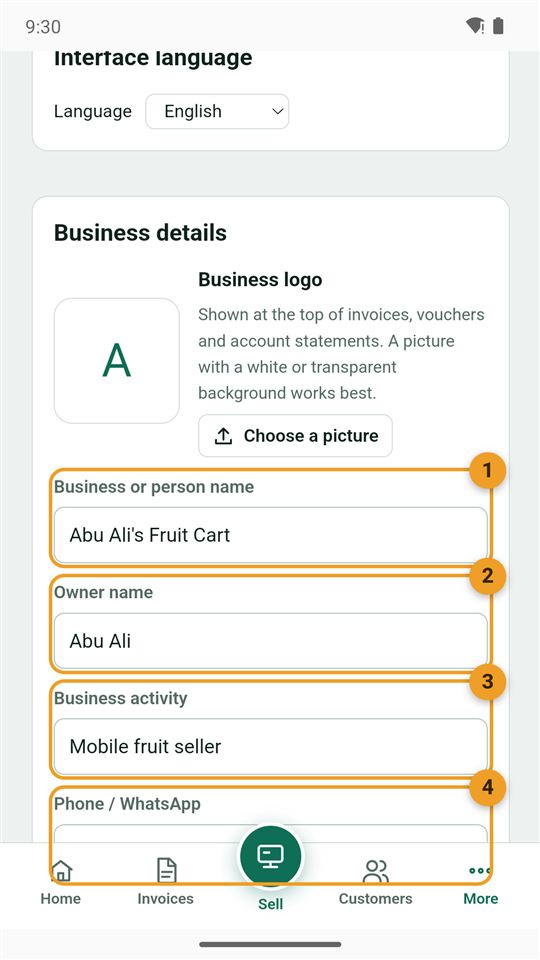
- The name.
- The owner.
- The activity: "Mobile fruit seller".
- The phone / WhatsApp.
3. Currency
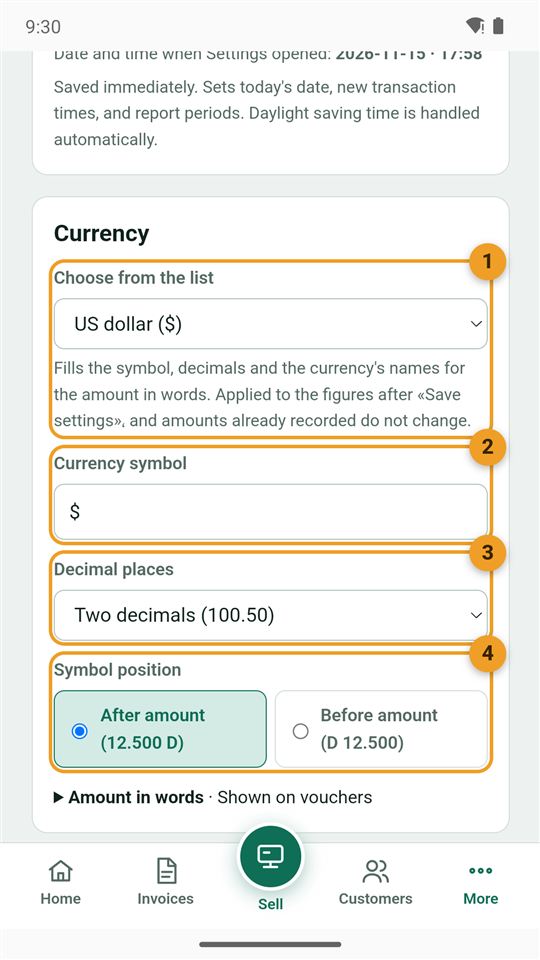
- The US dollar from the list.
- The symbol $.
- Two decimals.
- The symbol after the amount.
4. The supplier
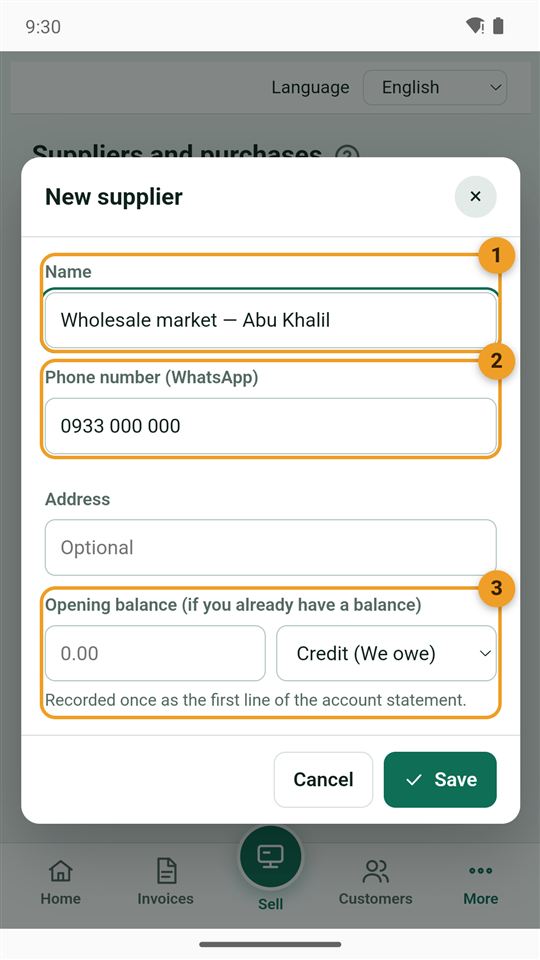
- Name: "Wholesale market — Abu Khalil", the trader he buys from.
- The phone.
- Opening balance: none.
5. The category
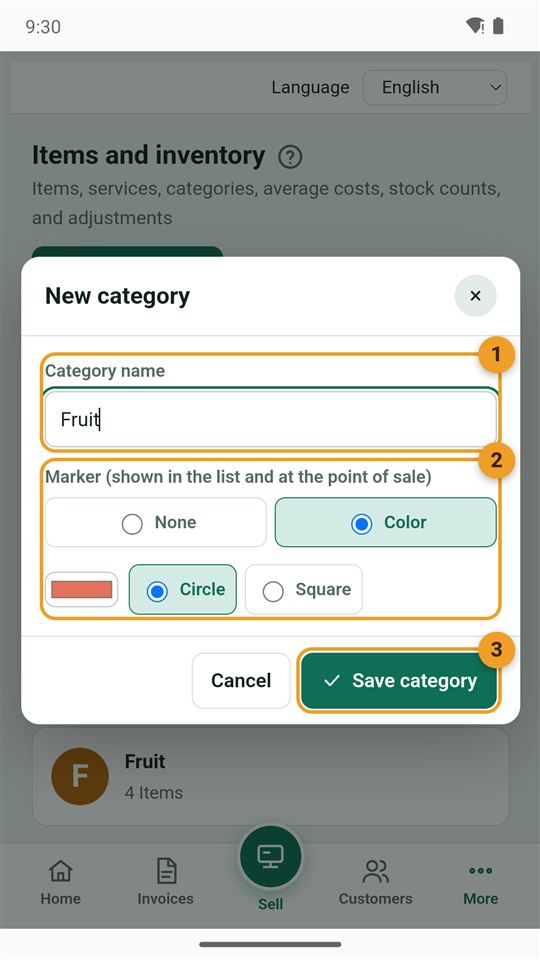
One category is enough: "Fruit".
- The category name.
- Its colour and shape.
- Save category.
6. Fruit by the kilo
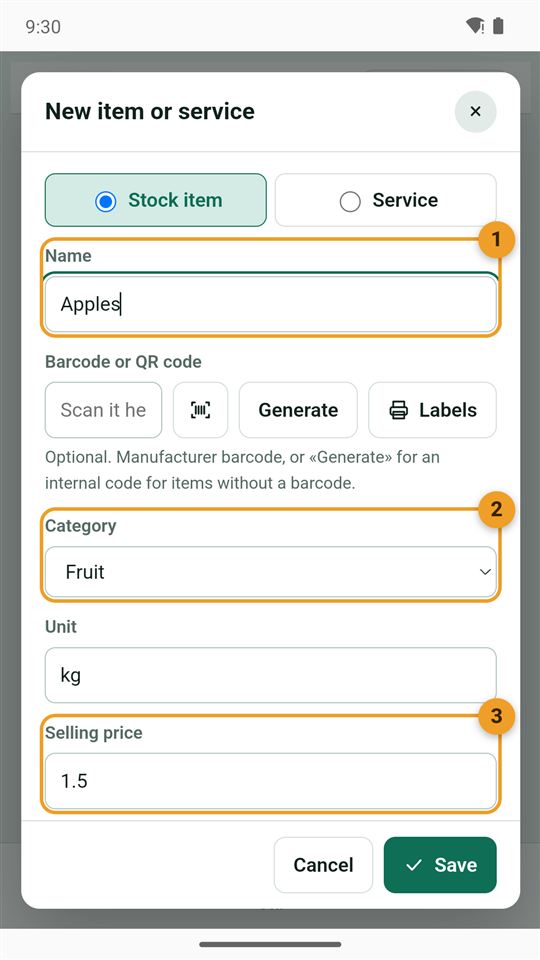
Apples $1.50 a kilo, bananas $1.20, oranges $1, grapes $2. What matters is the unit "kg": it tells the app the item is sold by weight.
- Name: Apples.
- Category: Fruit, with the unit: kg.
- Price per kilo $1.50, cost $0.90.
7. Buying wholesale
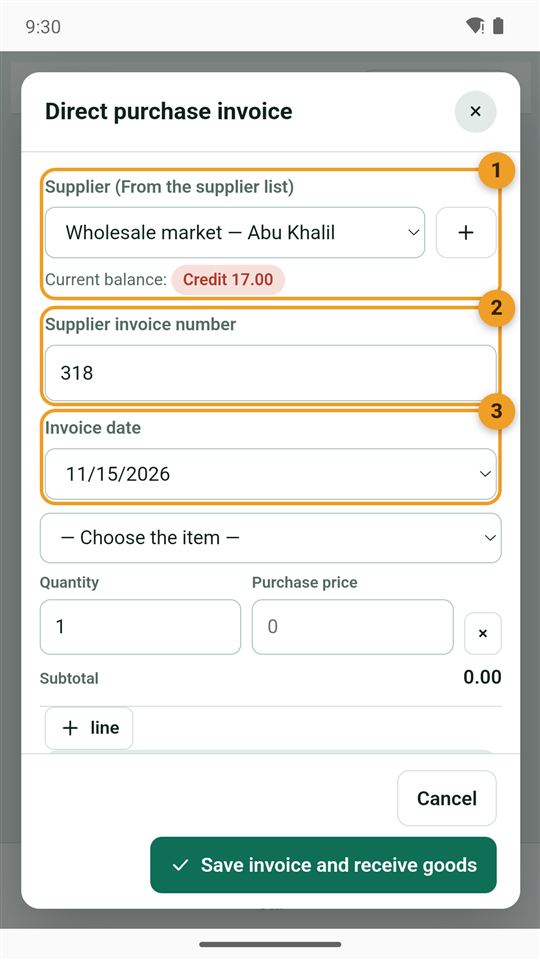
- The supplier: Wholesale market — Abu Khalil.
- The invoice number: 318.
- The date.
40 kg of apples, 30 of bananas, 40 of oranges and 15 of grapes: $97 in all. He paid $80 and still owes $17. Three days later he bought 10 kg of bananas and 10 of apples for $16 cash.
8. The first sale: 1.5 kg of apples
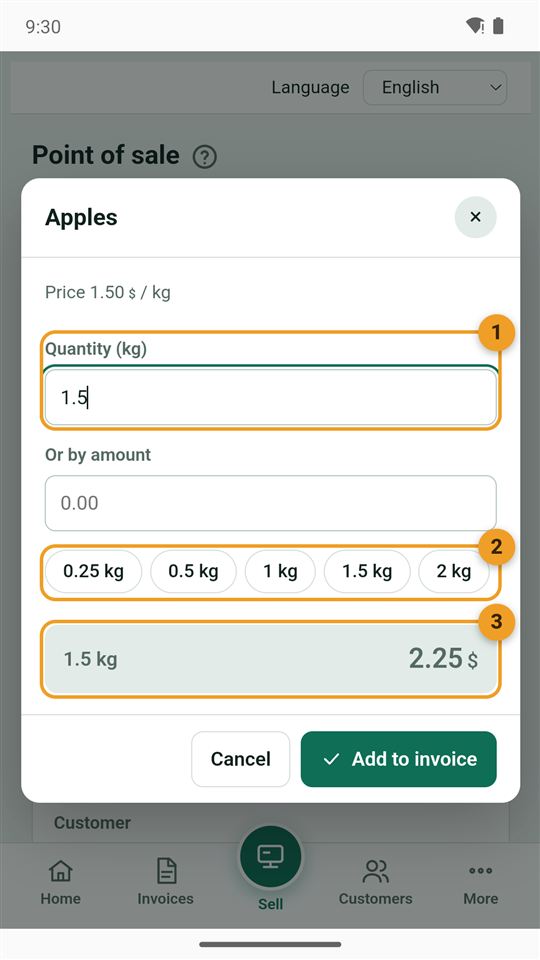
When he taps an item sold by the kilo, a small window asks: how much?
- Quantity (kg): 1.5. It can be typed to the gram, like 0.350.
- Quick amounts: a quarter, a half, 1, 1.5 and 2 kilos in one tap.
- The sum: 1.5 kg = $2.25, then "Add to invoice".
Selling by weight every day
"A dollar's worth of bananas"
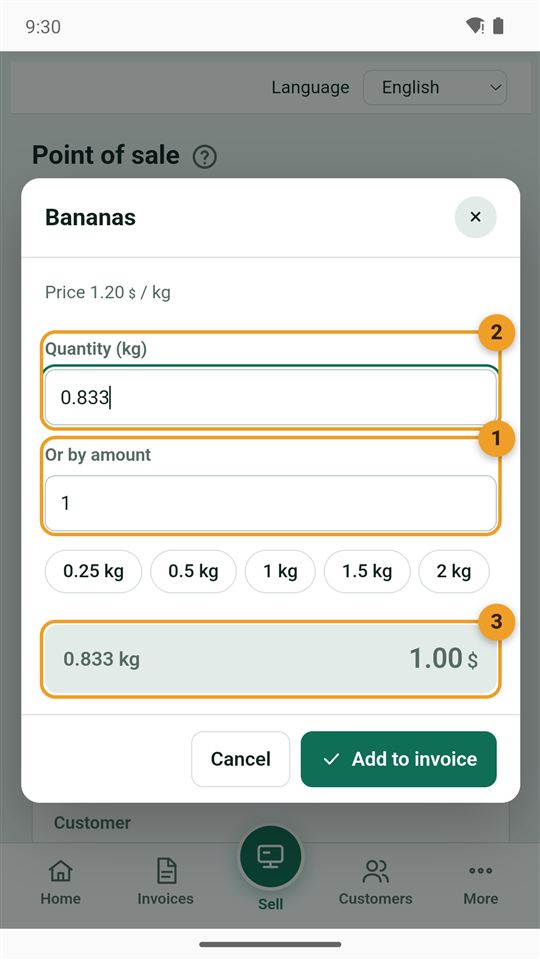
Many customers ask by money, not by weight. He types the amount and the app works out the weight:
- Or by amount: $1.
- The quantity follows on its own: 0.833 kg, so that is what he weighs.
- The sum: 0.833 kg = $1.00.
The invoice with weights
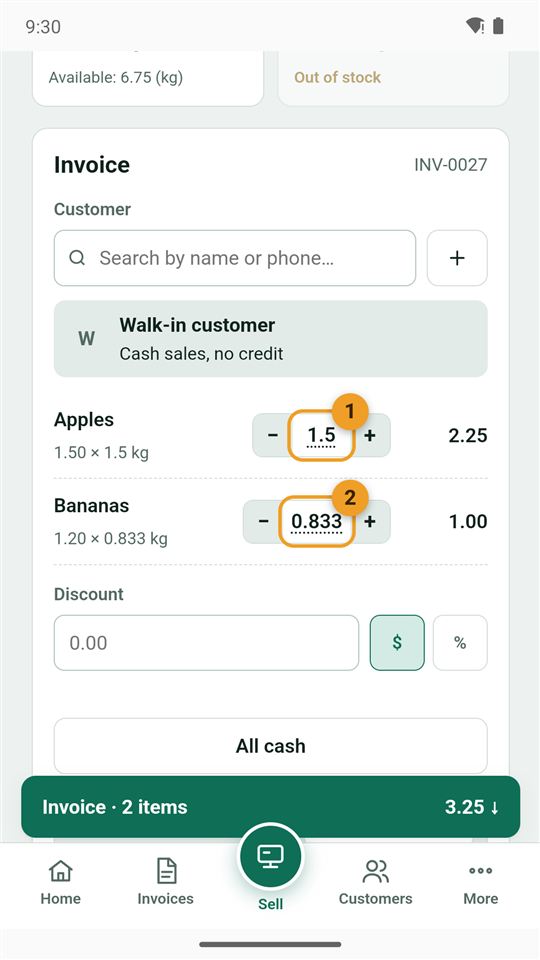
- Apples 1.5 kg = $2.25.
- Bananas 0.833 kg = $1.00. Tap the underlined number to change the weight.
- The total $3.25.
The + and − buttons add or take away a whole kilo; for an exact weight, tap the number itself.
Spoiled fruit
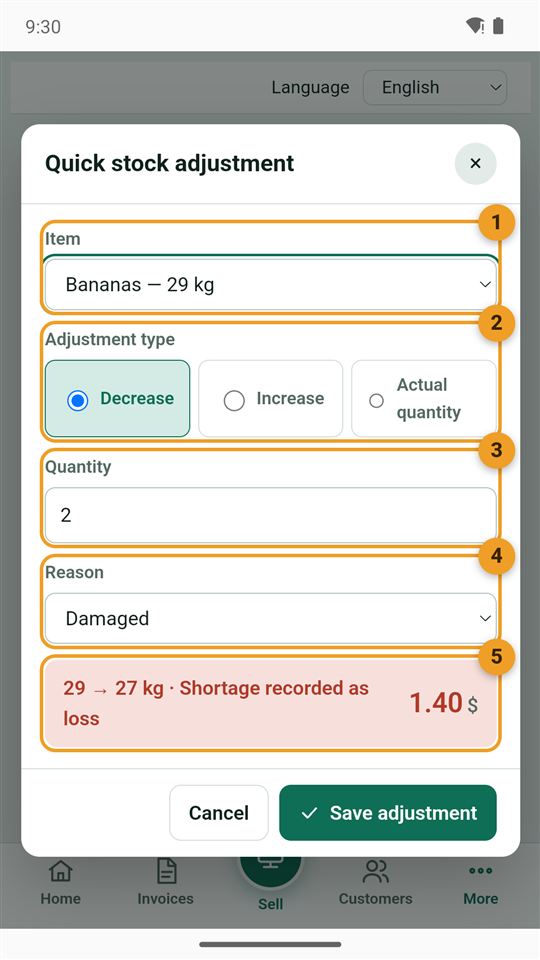
2 kg of bananas went black and can no longer be sold. From "Items and inventory → Quick adjustment":
- Item: Bananas.
- Adjustment type: Decrease.
- Quantity: 2 kg.
- Reason: Damaged.
- The result: 29 → 27 kg, a $1.40 loss at the purchase price.
The stock then matches what is on the cart, and the loss shows in the profit instead of vanishing.
Closing the day
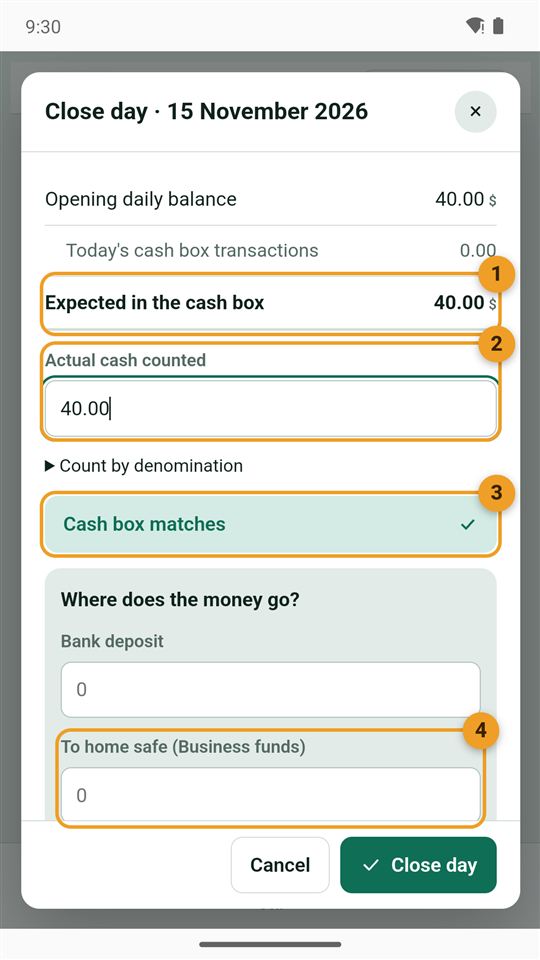
At the end of the day he counts the cash, from "More → Cash and bank → Close day":
- Expected in the cash box $40.
- Actual cash counted $40.
- Cash box matches: no shortage, no overage.
- To home safe: what he takes home, leaving the rest as change for tomorrow.
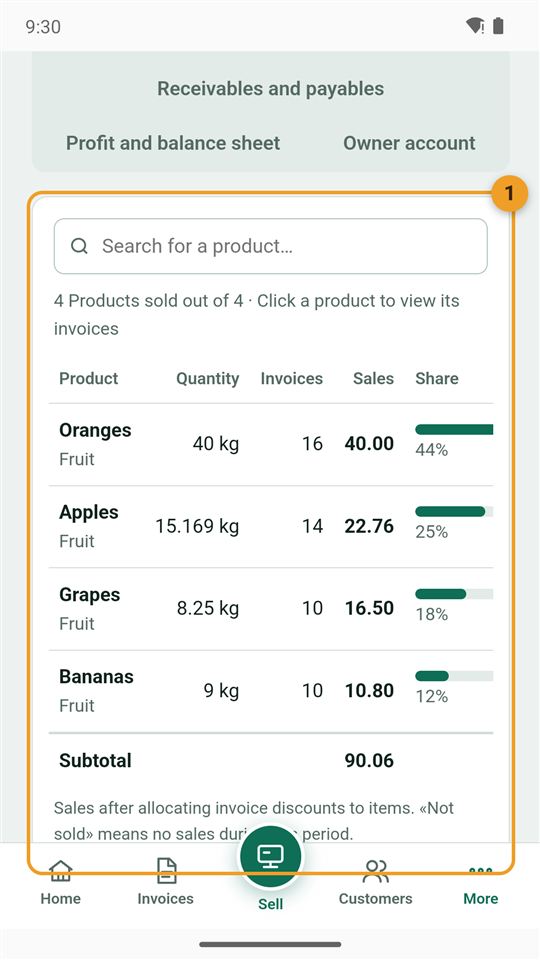
Which fruit earns most?
- Sales by product in kilos and money: oranges first, 40 kg for $40 at a 45% margin, then apples 15.169 kg for $22.76, grapes 8.25 kg for $16.50, and bananas 9 kg for $10.80.
A tour of the sections after a week
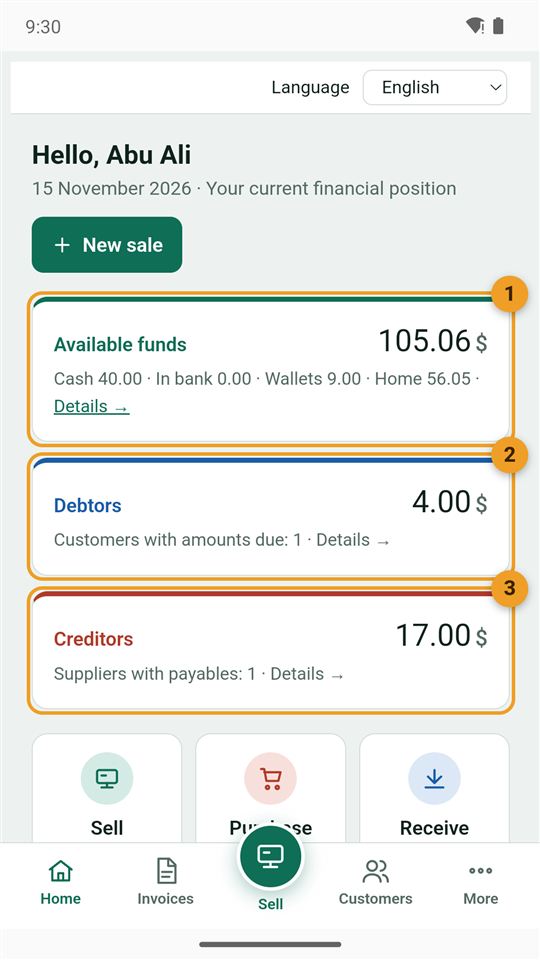
Home
- Available funds $105.06: $40 in the cash box, $9 in the wallet, and $56.05 he took to the home safe at closing.
- Debtors $4: what the café still owes.
- Creditors $17: what he still owes the wholesale market.
Invoices
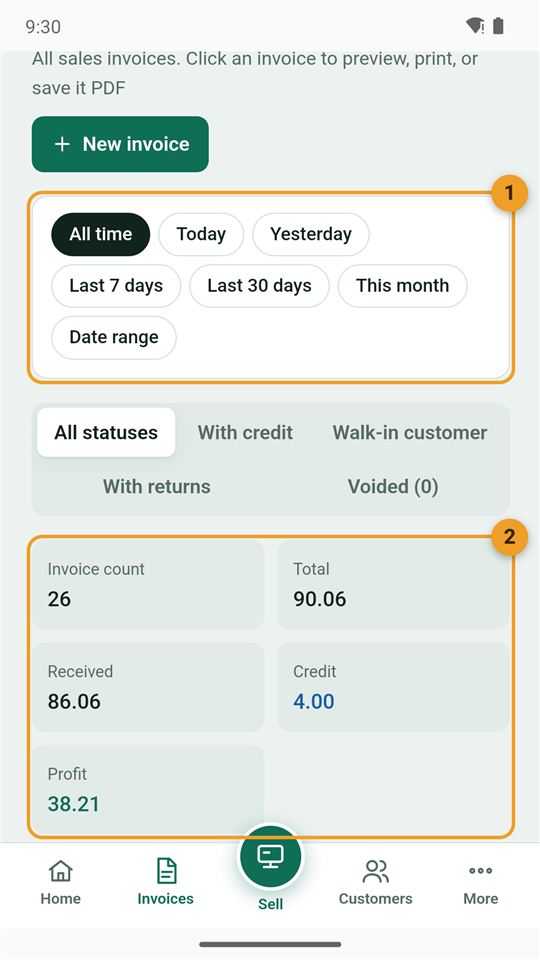
- The period.
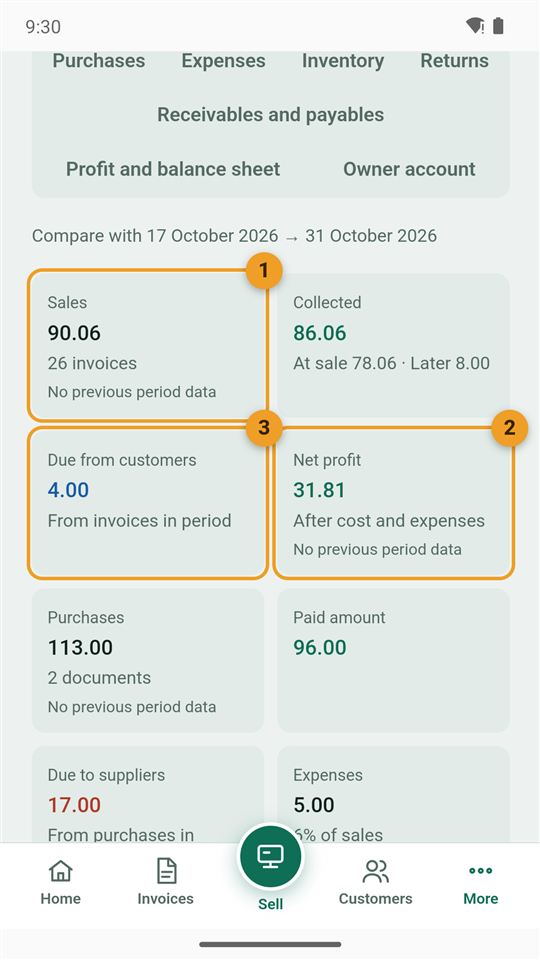
- The summary: 26 invoices for $90.06, $86.06 received and $4 on credit.
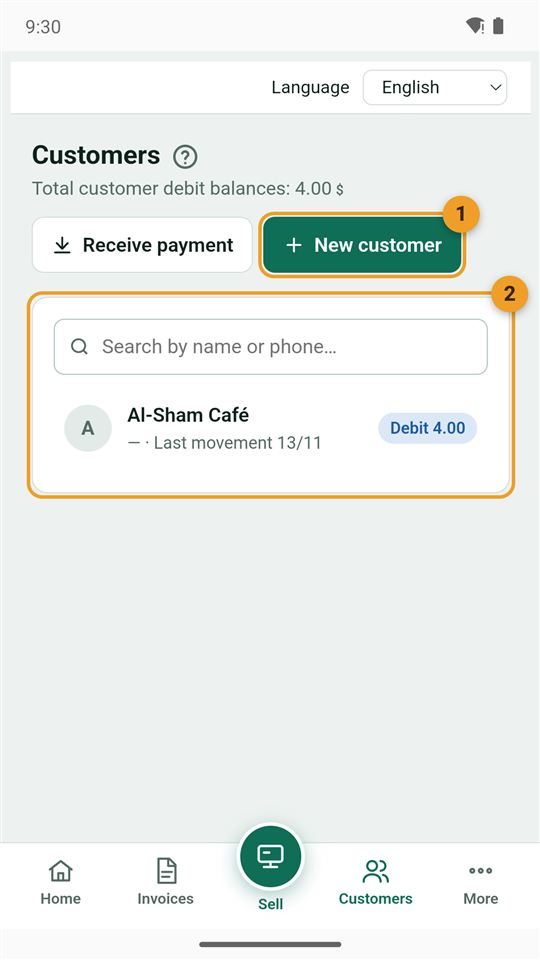
Customers
- New customer.
- The list: "Al-Sham Café" takes 6 kg of oranges for juice twice a week on credit; it paid $8 and owes $4.
Expenses
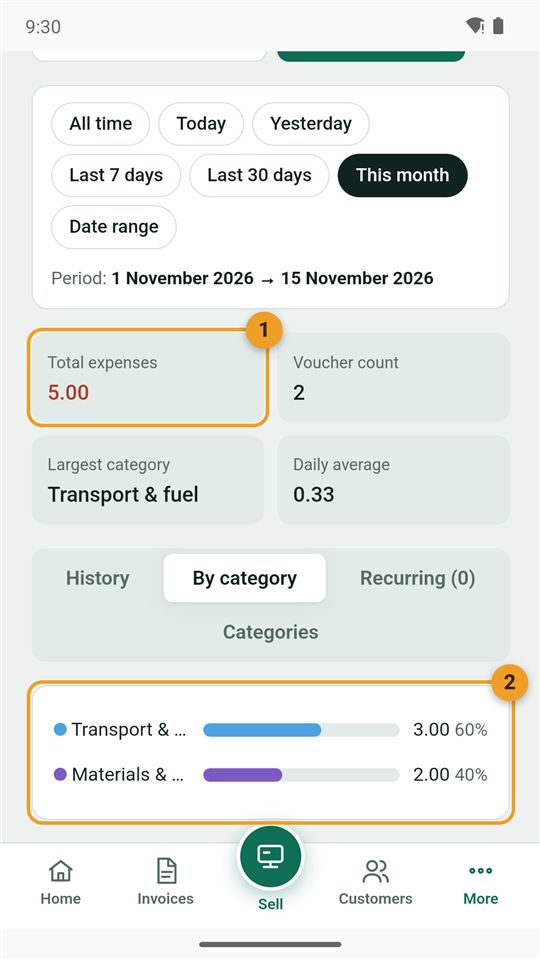
- Total expenses $5.
- By category: the van fare from the wholesale market $3, plastic bags $2.
Cash
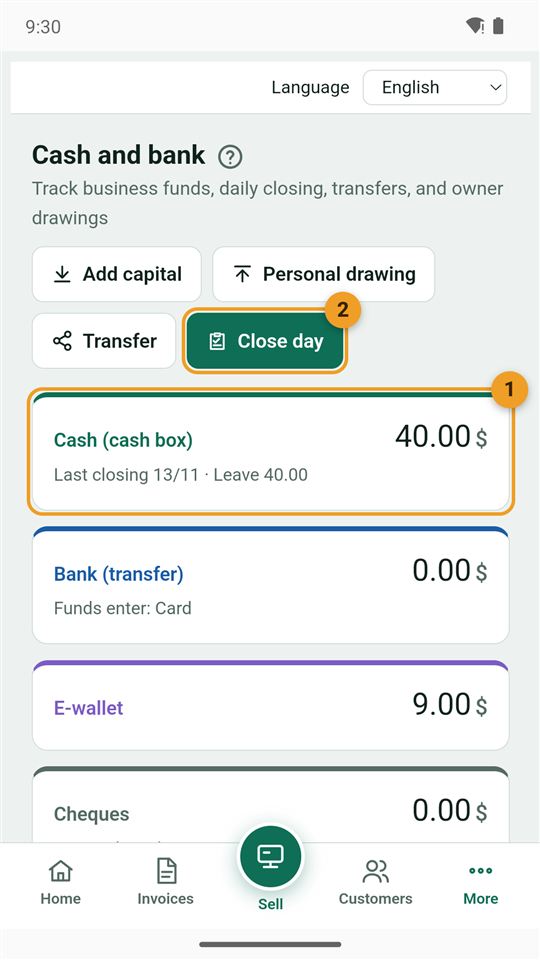
- Cash (cash box) $40; the last closing left $40 as change.
- Close day.
Reports
- Sales $90.06 in 26 invoices.
- Net profit $31.81 after the cost of what was sold, expenses and the spoiled bananas.
- Due from customers $4.
The fruit still on the cart is not in the profit yet: it is stock not sold. Read How do you know your real profit?